Anti-robotism
The Caves of SteelAnti-robotism is the hostility toward robots that grows from a conflict over work, status, and Earth’s future. It makes individual machines into targets for grievances created by economic policy, gives the Medievalist movement a base among people threatened by declassification, and frustrates Spacetown’s attempt to use robots as companions in a renewed program of human colonization. In the novel, opposition to robots is not merely a prejudice about artificial beings: it is a pressure point where the City’s carefully organized life meets the insecurity its own system produces.
Economic Roots and City Life
Earth’s Cities are presented as immensely efficient, self-contained environments. New York City covers more than two thousand square miles and has a population of well over twenty million; roughly eight hundred Cities across Earth average ten million people each. Their organization gathers residential Sections, administrative offices, factories, hydroponic plants, yeast-culture vats, and power plants into a coordinated urban system. This scale and efficiency constitute the achievement of City culture, but they also form a social order in which people are expected to live according to strict routines and scientific control.
Robotization unsettles that order because its gains are not experienced equally. A person who faces the prospect of declassification after years of effort cannot easily treat a robot as an innocent tool, even when the machine itself did not create the conditions that threaten that person’s livelihood and rating. An abstract policy or production slogan offers no immediate target; a robot can be struck at. The distinction between the source of an economic problem and its most visible representative helps explain why anti-robot feeling can become both personal and politically combustible.
The Commissioner places that pressure within a longer history of replacement. He tells Elijah Baley that the process has been under way for twenty-five years, since the Spacers arrived, and is now beginning to reach higher levels. The Police Department’s own future is implicated: mishandling the investigation into the murder of a Spacer could bring the point closer when officers could no longer expect their pension-tab booklets. The case therefore carries an employment and status anxiety that extends beyond any one worker or occupation.
From Resentment to Collective Threat
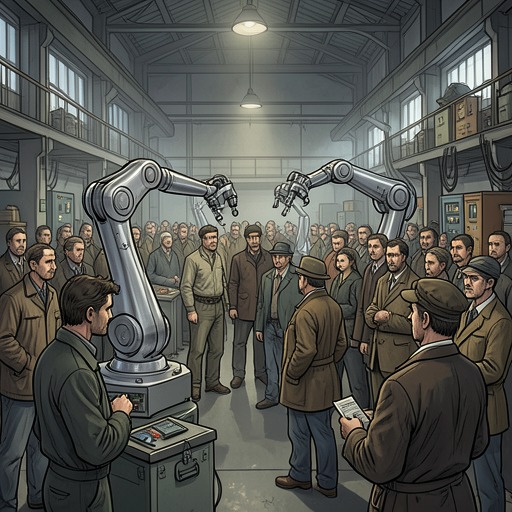
The novel connects the possibility of anti-robot violence to the tensions of tightly regulated City life. When people’s inhibitions build under routine and control, hostility can break out; the remembered Barrier Riots stand as an earlier instance of that danger. Those facing declassification may understand their prospects as the result of impersonal forces, but the individual robot remains more tangible than government policy. A crowd’s resentment can thus move from complaint to destructive action without the underlying conditions having changed.
The government describes the resulting upheaval as growing pains and promises that adjustment will lead to a new and better life. Yet the Medievalist movement expands alongside declassification. As insecurity deepens, the distance between frustrated opposition and uncontrolled destruction narrows. The promise of eventual improvement does not erase the immediate experience of threatened status, nor does it make a machine an acceptable symbol of the system responsible.
At a shoe store, this logic takes a plainly visible form. A customer objects to being served by robot clerks, rejects the manager’s evidence that they are registered workers, and insists that they are not men but robots. She accuses them of taking jobs, argues that the government protects them because they work for nothing, and links their presence to families being forced to live in barracks and eat raw yeast mush. Her demand that the machines be smashed expresses a broader grievance through the specific objects in front of her. The scene shows how anti-robot politics can recruit the language of respectability and hard work while treating the robot as the direct cause of conditions produced at a wider social level.
Political Stakes and Institutional Pressure
Anti-robot feeling also shapes the stakes of the investigation into Roj Nemennuh Sarton’s murder. When Baley questions why a case involving a murdered Spacer has apparently produced no visible progress, the Commissioner explains that the Terrestrial Bureau of Investigation regards it as a New York matter because Spacetown lies within the City’s jurisdiction. That local authority exists alongside the Spacers’ extraterritorial rights, which let them insist on their own investigation and report to their home governments.
The jurisdictional conflict is politically dangerous in part because the Outer Worlds could use the murder as grounds for indemnity charges. The Commissioner warns that agreeing to pay could amount to political suicide, while refusing could bring another kind of suicide. Anti-robot tension therefore sits within a broader struggle over power between Earth and the Outer Worlds: the case must be handled amid both domestic anger toward robots and the consequences of an international dispute.
Spacetown’s role is especially paradoxical. Dr. Han Fastolfe explains that introducing robots on Earth is intended to upset the balance of the City economy. The resulting group of displaced men is meant to become a nucleus for colonization: people with little to lose on Earth and new worlds to gain by leaving it. Fastolfe presents this as a deliberate answer to the City’s failure to offer such men a future, not as a policy designed out of cruelty. But the plan depends on a response that anti-robot resentment makes difficult to achieve.
Colonization, Limits, and Meaning
Fastolfe acknowledges that the strategy is not working. Earthmen’s resentment of robots blocks the process, even though robots could accompany human settlers, ease the difficulties of initial adjustment to an undeveloped world, and make colonization practical. The technology that might help people escape the limits of the City is rejected because it is also associated with their displacement within the City.
This contradiction places anti-robotism between present insecurity and a proposed future. The City promises order, efficiency, and collective provision, yet its economic arrangements can make individual people feel expendable; colonization offers an alternative, but the means of preparing for it intensify resentment at home. Robot opposition is therefore both a response to real social pressure and an obstacle to the remedy proposed by Spacetown.
The concept also changes how the murder investigation can be understood. Baley considers the possibility that Sarton’s work on converting Earth to C/Fe threatened conservative groups or Medievalists because it might succeed, giving them a motive to kill him. The suspicion connects hostility to robots with resistance to a larger technological and social transformation, though the conversation presents this as a line of reasoning rather than a fact established by the quoted exchange. Anti-robotism consequently operates at several scales: as a worker’s grievance, a crowd’s potential for violence, a movement growing amid declassification, and a political force affecting relations between Earth and the Outer Worlds.
Status, Evidence, and the Human-Machine Boundary
The hostility is reinforced by an unequal legal position. Baley observes that a robot cannot serve as a witness in an Earth court because robots have no status there. Even a robot able to remember two faces amid a huge crowd would not, on that basis, be accepted as a human witness. The distinction matters beyond public sentiment: institutions that define a robot as legally inadmissible limit the machine’s power to establish facts, while leaving its labor and social presence consequential.
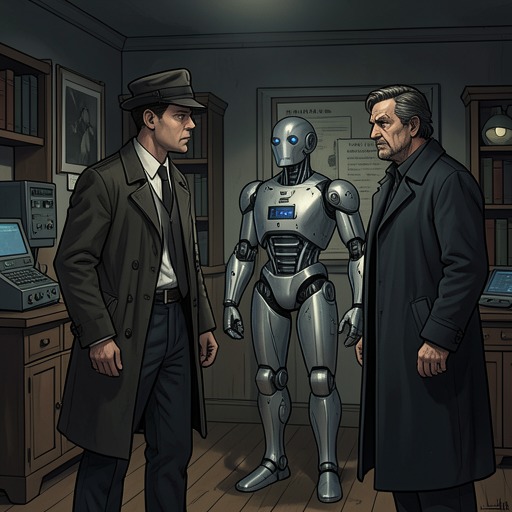
Everyday encounters likewise mark the boundary between City dwellers and Spacers. At Spacetown, R. Daneel Olivaw advises Baley to shower before entering, explaining that the facility has no personal-hygiene facilities for City visitors once inside. Baley’s blood is also analyzed at the entrance, a procedure that prompts anxiety about the thoroughness of Spacer medical scrutiny. Such protocols do not themselves demonstrate anti-robotism, but they place the human body, its classification, and the rules of access within the same broader setting of suspicion and difference. Meanwhile, R. Daneel’s composed appearance in Earth-style clothing initially makes the distinction between human and robot difficult to read, underscoring how social and legal categories cannot be inferred simply from outward form.
Anti-robotism thus exposes a fault line in the City’s account of its own progress. Its systems promise rational organization, yet people experience robot labor through the immediate risks of job loss and declassification; political leaders describe adjustment as temporary, yet the promised future remains uncertain. The machine becomes a convenient object of opposition precisely because it is visible, while the policies and institutions behind the conflict are harder to confront. That displacement of blame helps explain both the movement’s appeal and its capacity to obstruct a future in which robots might serve human communities rather than stand against them.